Showing posts with label democrats. Show all posts

Monday, 21 November 2011

The Healing Power of Hope (Satis Shroff, Germany)


World Healing Poetry: 
The Healing Power of Hope (Satis Shroff)

Unto you that fear my name
Shall the sun of righteousness
Arise with healing in his wings
(Malachi)

Bridges of peace, friendship and togetherness
Are built on mutual respect,
Tolerance and Miteinander.
We must talk about the symbols
Of tyranny in your villages, towns and cities.

On Memorial Day we gather with earnest faces,
To honour and remember the people
Whose names are engraved on stones,
Who died in the two World Wars.
The suns and husbands have fallen,
But a new ghost raises its ugly head again,
The Neonazis who work for
The Bundesnachrichtendienst.,
Who receive money for their incompetence,
In Thuringen, Saxony,
Hessen and Lower Saxony.

The lesson of faschism taught us
Never to combine
The police with the secret service,
For it would be akin to the Gestapo,
The Geheimen Staatspolizei.
The sixteen secret services in Germany
Cannot coordinate and cooperate.

Since thirteen years have we given
Neonazis a free hand,
Who robbed banks,
Executed Turkish and Greek migrants.
The constitution makes it possible:
‘Germany for the Germany,
All aliens out!’
Long live the Freedom of Speech.
But prithee, where is the protection
Of the migrants and underdogs
Of the society?
Is a new holocaust in the offing?

Yet there is no way
But the path of peace and togetherness.
The ewig gestrigen and the neos
Are still licking the wounds of war,
Wounds that won’t heal,
For they are infected with hate anew,
With brown-propaganda.

War has always been ugly and brutal.
The widows of the on-going krieg in the Hindukush,
The survivors who don’t understand their own world,
After the trauma of Vietnam, Irak, Afghanistan.
When the NATO sirens are tested,
The air vibrates with a monstrous noise.
Fear makes the olde soldier’s heart beats faster,
His pulse races and he almost chokes.
The memories and the fury of war overwhelm him.

Who will restore the faces we’ve adored?
Love, faith, togetherness and peace
Haven’t been lulled to sleep.
We still hear the clarion call
To the dangers of war,
To the hoarse shouts
Of the Neos in the street,
Who strut and fret,
And believe Auschwitz was a lie.

A silence treads like clouds shadows,
Among the people of Germany.
Hope hasn’t abandoned us yet,
Despite the petite victories of the rightists,
In Germany, Switzerland and Austria.
The people in these lands
Think otherwise.

In every good person there is a bad part,
In every bad person there’s a good trait,
Like ying and yang.
We can only appeal to humans,
Hope and pray for peace,
And the old wounds to heal,
Between humans in this world.

Saturday, 7 May 2011

The Chance to Change (Satis Shroff)


THE CHANCE TO CHANGE (Satis Shroff)

“Education is the best thing in the world for Nepal’s children, be they Gurkhas, Sherpas or Madeshis. And what Nepal needs most in this crucial transitional period is peace, co-operation between the different ethnic groups, a craving to mend ways, build bridges between its cultures, connect and find common goals.”Satis Shroff

Mr. Swaroop Chamling, who is a Rai and ex-Gurkha settled in UK, is gathering signatures for a Gurkha petition on www.Darjeeling Forum (google or yahoo search will do) and I find it interesting that the Gurkhas, civilians and military, are getting organised to fight for their rights at last, after years of discrimination, hiring and firing, and low-pay on the part of the Ministry of Defence (MoD) in Britain. What I found interesting was the inference of a Gurkha reader on www.Gurkhas.com that it was Bahuns and Chettris all the way in Nepalese history and even today, whether in the opposition or in the ruling parties. The same sort of infighting that you see in Delhi between the Punjabis, Bengalis and other Indian ethnic groups is to be seen in Catmandu’s ministries. It’s always Newars versus Bahuns and Chettris, with the rest of the ethnic groups as onlookers. If you want to make a career in Catmandu you have to learn the local lingo, which is a language with monosyllables---Nepal Bhasa. 

It is a fact that there are only bahuns and chettris of the higher caste on both sides: among the maoists and political parties in Nepal. The reason why bahuns and chettris dominate the political, economic and other landscapes in Nepal is that they have been privileged through Hinduism,  its raja-praja set-up and caste-system, with its purity and pollution implications that have swept and divided the families in Nepal and the Nepalese diaspora for centuries (as in India even today), and I think that Dor Bahadur Bista has illustrated this amply in his writings, and was cursed wrongly by critics in Catmandu and elsewhere as a 'Nestbeschmutzer.'

One can combat this discrepancy by uniting to create a new, ethnic-friendly Nepal by decree of law, and by observing the new democratic developments in Nepal as a chance to change the old, federal structures and bringing in a secular state, like our big neighbour India. India did, what Nepal is in the process of doing, by introducing Privvy Purse for the Royals fifty years ago. The king has been sacked and the Narayanhiti Palace now a museum, just like the Hanuman Dhoka palace which can be viewed by Nepalese and tourists alike, and should act as an incentive for young Nepali school-kids to preserve the democratic rights of the country, lest it fall in the wrong hands, and not let history repeat itself.

The Nepalese society finds itself in a period of transition and has yet to decide which form of government is suitable and practicable for the society. Naming the former anchals or zones as cantons alone won’t make a Switzerland out of Nepal, but the will of the people to live under a governmental form based on public opinion and votes might bring this Himalayan country closer to the wishes of its people.

I remember the first page of The Rising Nepal bore the latin words: vox populi, vox dei. That was a time when a king and reincarnation of Vishnu ruled the land. The king had to sadly realise that the voice of the people was not the voice of God. And the voice of the king was certainly not the voice of the people. It was perhaps the voice of the ghost-writer. And thereby hangs a tale.

Education is the best thing in the world for Nepal’s children, be they Gurkha, Sherpa or Madeshi.  And what Nepal needs most in this crucial transitional period is peace, co-operation between the different ethnic groups, to mend ways, build bridges between its cultures, connect and find common goals.

But there’s the beginning of democracy in Nepal now, and the tribes and castes that were neglected in the past should get their rights by creating a federal form of government, like in German or in Switzerland, whereby the country has to be formed administratively as federal, local government with the power to carry out trade and commerce with neighbouring countries or states. Only then will there be a freedom of trade and commerce in all geographical and ethnic sectors.

The way it has been in the past: Kathmandu was Nepal. It was too centralised, the King lived in Kathmandu, the parliament was, and still is, in Kathmandu. Even for small things one had to have Kathmandu’s blessings. I hope the new governments will see to this matter and think of Nepal holistically, and not like in the past. I say government, because the political situation hasn’t shown much stability in the past for observers abroad.

Nevertheless, there is hope, and this torch of hope will be carried by the children and youth of Nepal. Whether we are Gurungs, Tamangs, Chettris, Bahuns, Bhujels, Kirats or Madhesis we have to unite and make Nepal a land that we can be proud of through our own endeavours. To borrow a line from JFK ‘ask not what your country can do for you, ask what you can do for your country.’ After all, we are a republican democracy, aren’t we?

The comity of nations would only be too willing to see a politically and economically stable Nepal and render assistance as in the past, before the war between the government troops and the maoists began.

So let us unite above the communal feelings and ideologies, and think in terms of Nepal as a nation, and not in terms of the opposite of democracy, namely anarchy. Let the children of Nepal from the plains and the hills have the same educational opportunities and work under human conditions. Let us show the world that we have a word for negotiation in our language, and that we also have the ability of carrying out a dialogue in the parliamentary sense of the word.

Peace, trust, faith, character, integrity, tolerance, dignity are qualities that cannot be attained by nurturing communal feelings and ethnic hatred. It is only through peaceful means, trust, honesty, cooperation and coordination that the long arduous task called development can be attained and the people can attain mental, physical and social wellness in the tedious march towards progress. To this end, we have to decide to change. Revolution is change, and the young men and women who were fired by their imagination during the decade long krieg have to do so in a constructive way, or else Nepal will forever remain ‘a yam between two rocks’ and a perpetual member of the least developed countries, in every sense of the word.

Change or perish should be the battle-cry of democracy loving Nepalese.
 Yes we can, if we want it strong enough.

About the Author:
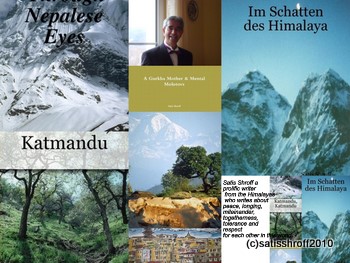
 Satis Shroff teaches Creative Writing at the University of Freiburg and the VHS Freiburg, and is the published author of four books on www.Lulu.com/satisle : Im Schatten des Himalaya (book of poems in German), Through Nepalese Eyes (travelogue), Katmandu, Katmandu (poetry and prose anthology by Nepalese authors, edited by Satis Shroff). His lyrical works have been published in literary poetry sites: Slow Trains, International Zeitschrift, World Poetry Society (WPS), New Writing North, Muses Review, The Megaphone, Pen Himalaya, Interpoetry. Satis Shroff is a member of “Writers of Peace,” poets, essayists, novelists (PEN), World Poetry Society (WPS) and The Asian Writer. He also writes on ecological, ethno-medical, culture-ethnological themes. He has studied Zoology and Botany  in Nepal, Medicine and Social Sciences in Germany and Creative Writing in Freiburg and the United Kingdom. He describes himself as a mediator between western and eastern cultures and sees his future as a writer and poet. Since literature is one of the most important means of cross-cultural learning, he is dedicated to promoting and creating awareness for Creative Writing and transcultural togetherness in his writings, and in preserving an attitude of Miteinander in this world.
He lectures in Basle (Switzerland) and in Germany at the Akademie für medizinische Berufe (University Klinikum Freiburg) and the Zentrum für Schlüsselqualifikationen (Lehrbeauftragter für Creative Writing, Albert Ludwigs Universität Freiburg). Satis Shroff was awarded the German Academic Exchange Prize and the Culture Prize of Green City Freiburg for his social engagement for the refugees and asylum-seekers.